
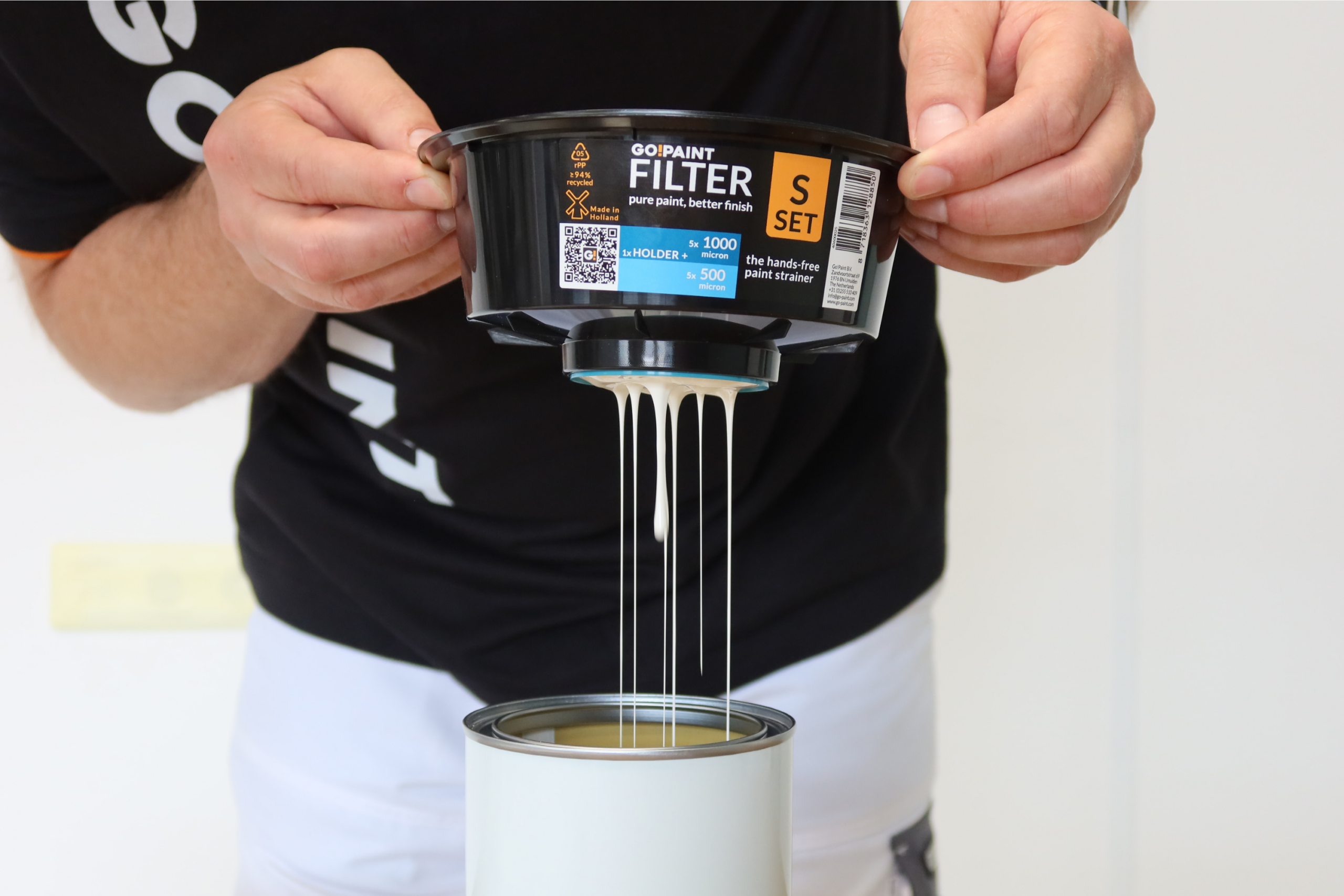
There’s nothing more annoying than finding hard bits, flakes and other dirt in your paint. Straining paint is a smart solution that saves you paint, time and money. And ultimately delivers a better finish. There are already various paint strainers on the market, each with its own advantages. GO!PAINT also has a new range of paint strainers. These have been specially developed to make it easier to strain paint, coatings and other liquids without having to stand by them. So they can be used hands-free.
When should you strain paint?
As soon as hard particles, dust or other contaminants have got into the paint, you can strain it.
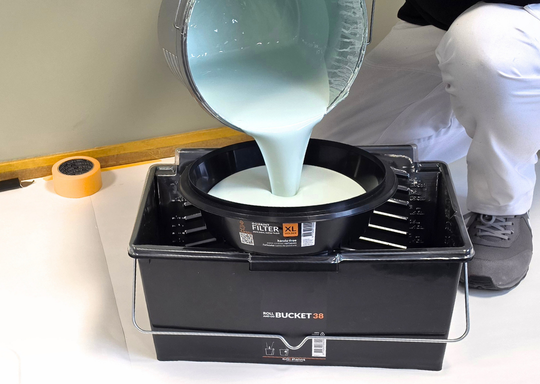
Straining paint saves a lot of hassle, as picking particles out of the paint afterwards is not only inconvenient but also damages the paint finish.
A good opportunity to strain the paint is immediately after opening the main container. With wall paint, you can strain it when the bucket is being used for a second time.
- Small particles are easily noticeable in lacquer work. You want a flawless finish, particularly on smooth surfaces such as doors, window frames and furniture. For a mirror-finish door or other high-gloss projects, sieving paint is absolutely essential.
- It is also recommended to sieve wall paint if the bucket is being used for a second time or has been left open for a while. When sieving wall paint, choose a sieve or filter with a larger mesh size than you would use for varnish.
- When spraying paint, a (fine) paint strainer is almost always used to prevent your spray gun from becoming blocked. You can also fit a GO!PAINT paint strainer to a hopper if you’re going to be spray painting. This prevents the system from becoming blocked (any sooner) and ensures you make the most of your paint.
Another good time to strain the paint is at the end of the project, when there is some paint left over. Pour this back into the original container or a smaller new container through the FILTER, so that you only keep the pure paint.
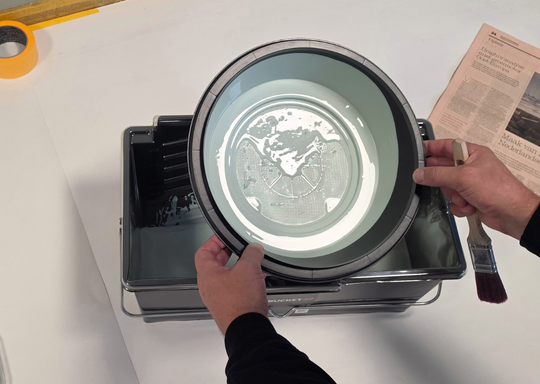
There are also situations where you may need to strain the paint whilst you’re actually painting.
For example, if dust or pollen gets into the paint, or if you’ve picked up dust on your brush whilst painting. And sometimes you might unexpectedly come across a small skin in the paint that initially looked fine.
What types of paint strainers are there?
There are various types of strainers in terms of shape and material, each with its own advantages and disadvantages. The most commonly used strainers are paper (disposable) cone strainers, cup filters for spraying, nets (or tights) or reusable filter systems.
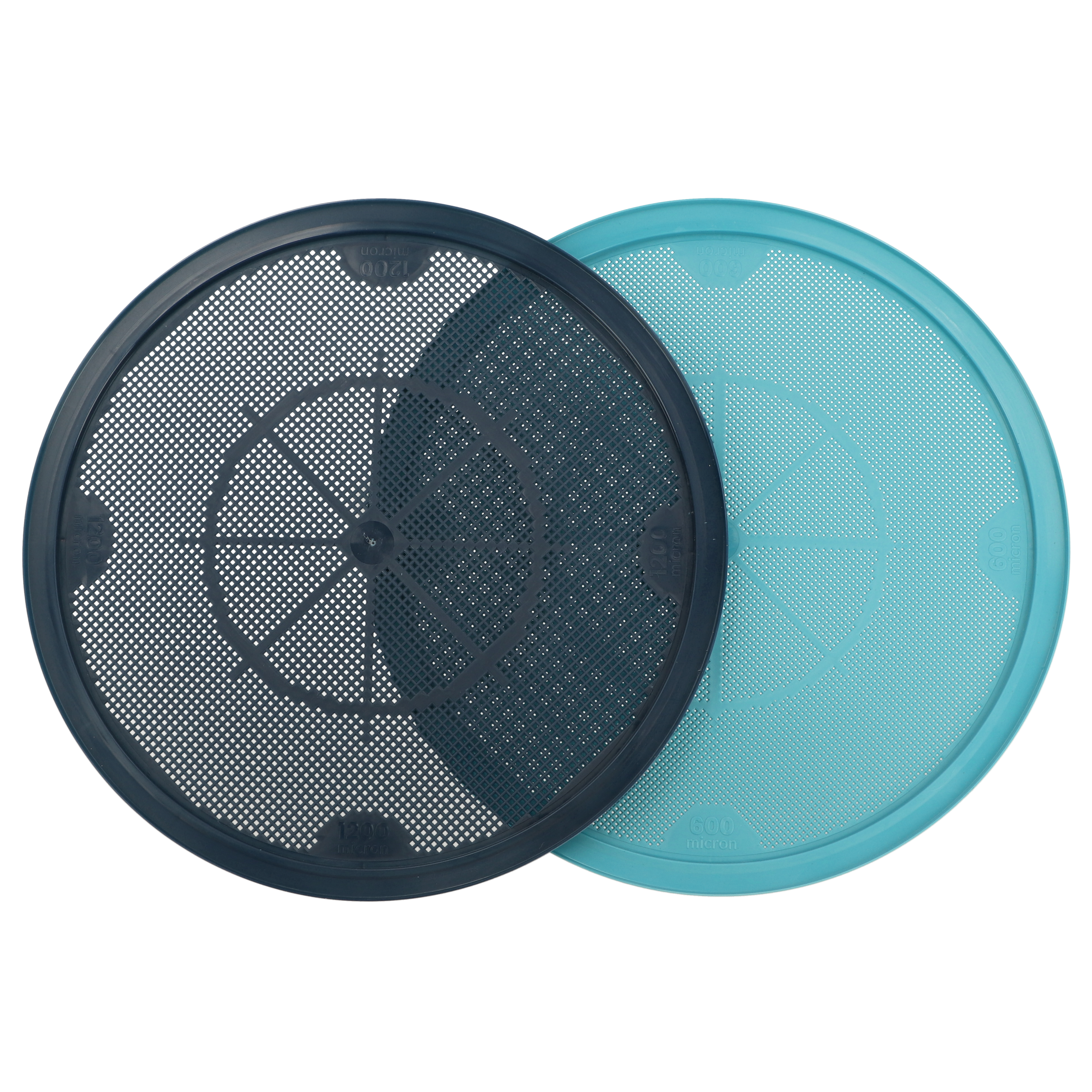
Choosing a mesh size
Depending on the paint thickness and temperature, as well as the speed and accuracy you require, you should choose a mesh size.
This is also referred to in microns: the lower the number of microns, the finer the filter.
Step-by-step guide: how to strain paint easily
- Always start by stirring the paint thoroughly with a clean paint stirrer.
- Place your strainer on top of a bucket, can or hopper.
- Pour the required amount of paint through the strainer into the paint bucket or tray you intend to work from.
- Allow the paint to flow through slowly. This ensures you always start with clean paint.
In this video, you can see just how simple the GO!PAINT filter system is to use.
The benefits of the new filter system:
- Hands-free – you can get on with something else whilst the paint is flowing through
- Suitable for paint cans, buckets and hoppers
- For all types of paints, coatings and lacquers
- Reusable and easy to clean
- Made from 100% recycled material
Frequently asked questions
How does the new filter system work?
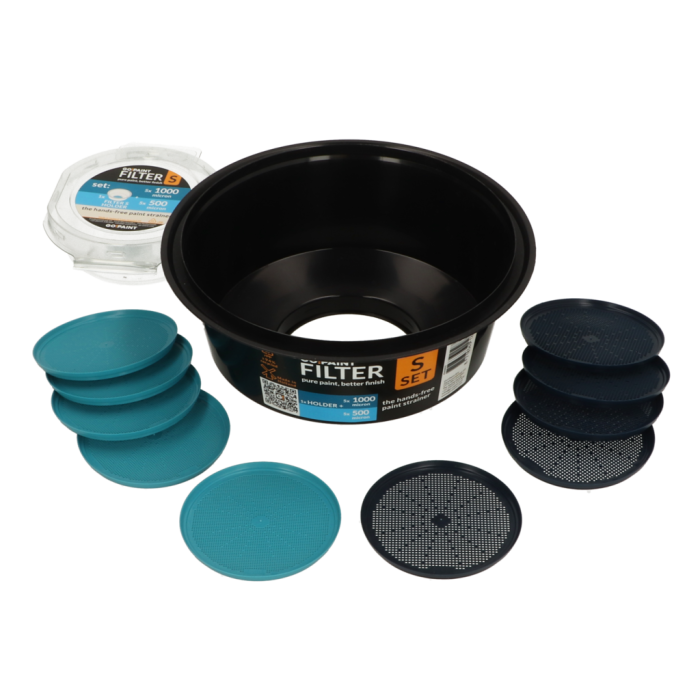
GO!PAINT has developed two sizes of filter holders into which you can click a replaceable filter as a base. The small version, FILTER S, holds up to 1 litre of paint, whilst the large version, FILTER XL, holds up to 5 litres of paint.
You can use it when you start painting. Place the strainer holder with the strainer on the scuttle or bucket you want to paint from, or on top of the hopper if you’re spray painting, and pour the paint in.
You can also use it after painting. Simply place it on top of the container in which you wish to store the paint and pour the leftover paint over from the container you were working from.
Let gravity do its work and allow the paint to drain slowly whilst you get on with something else. Or speed up the process by stirring the paint through the filter with a brush or stirring stick.
How fine should my filter be?
Filters (strainers) have different mesh sizes, expressed in microns or micrometres. A larger mesh size allows material to pass through more quickly, whilst a smaller mesh size is more precise. If you’re working with a thicker paint, such as wall paint, it’s best to choose a larger mesh size, such as 1000 or 1200 microns. If you’re working with a highly fluid product, such as a fine gloss paint or a wood stain, it’s better to choose a smaller mesh size, such as 500 or 600 microns.
Can I use the filters for more than just paint and lacquer?
Of course, the filters can also be used with other liquid products that may contain particles, such as oils – for example, furniture oil or floor oil – or even powdered products that contain lumpy bits.
How can I use the filters when spray-painting?
Place the FILTER S or XL on the spray gun’s cup or hopper and pour the spray paint into it. The main advantage is that any contaminants remain in the filter and do not settle at the bottom of the cup or hopper, where they could block the final filter – which can lead to annoying spluttering and spattering from the spray gun.
How can I reuse the filter?
Place the filter upside down on an old newspaper, sheet or drop cloth. Press the filter out of the holder and leave it to dry. If you’ve been using lacquer, we recommend throwing it away. If you’ve been using water-based paint, you can clean the sieve. Simply wipe the holder clean with a (moist) cloth and you can reuse it many times.