
The Packaging and Packaging Waste Regulations (PPWR) introduces significant new compliance across the entire packaging supply chain. Whether you are a manufacturer, importer, or distributor of packaging, like paint cans, pails, drums, IBCs, cartridges, or aerosol containers, you must comply. To help you better understand the PPWR, we’ve put together a list of the most important questions and answers for you. We’ve also provided a checklist for you to download – a practical guide to help you move forward.
Frequently asked questions
What is the PPWR?
The Packaging and Packaging Waste Regulations (PPWR) introduces significant new compliance burdens across the entire packaging supply chain. From 12 August 2026, every economic operator placing packaging on the EU market — whether as a manufacturer, importer, or distributor of packaging, like paint cans, pails, drums, IBCs, cartridges, or aerosol containers — must ensure that packaging undergoes a conformity assessment, is supported by technical documentation, and is covered by a valid EU Declaration of Conformity (DoC).
Where can I find the PPWR regulations?
The original document can be found on the website of EUR-Lex in 24 European languages.
I am not a packaging manufacturer. Why is The PPWR still important for me?
The PPWR have another understanding of the term manufacturer/producer than you may think. For PPWR anyone who fills packaging or orders packaging to be filled with product(s) and is the first to place this filled packaging on a European market, is actually the Producer of the packaging.
Who is the Producer and what are my responsibilities if I am seen as the Producer under PPWR?
Under the PPWR, the producer is the economic operator — typically the manufacturer, importer, or distributor placing packaged products on the market under its own name or trademark — that bears Extended Producer Responsibility (EPR) obligations. This means registering in the Article 44 producer register, contributing financially to packaging waste management, and ensuring eco-modulation of fees.
I buy Go!Paint products from you, and sell these products in Europe to my clients in my stores and/or through my webshop. What is my PPWR role?
If you sell our products under the Go!Paint brand, Go!Paint is seen as the Manufacturer of the packaging and you are seen as the Distributor. However, if you sell our products under your own brand name or label, or make changes to the products and/or the labels, you are the Producer/manufacturer according to the PPWR definition.
Do hardware and paint stores selling Go!Paint tools under their own brand qualify as producers or manufacturers? And how does that work for paint?
Yes. A hardware or paint store selling our tools under its own brand is generally both:
- Manufacturer: it commissions or markets the products under its own name or trademark and is responsible for PPWR conformity, technical documentation, and the Declaration of Conformity for the packaging.
- Producer: it is normally the party placing that branded packaged product on the relevant national market and therefore has the applicable EPR obligations.
For paint packaging: The contract filler may physically manufacture the paint or can, but the own-brand retailer is usually the PPWR manufacturer—not merely a distributor. A limited exception may apply to qualifying micro-enterprises using a same-country supplier. (PPWR & system participation: own brands and imports)
What are the PPWR obligations of a Distributor?
A distributor‘s obligations are more limited than those of the manufacturer. The distributor must generally verify that:
- the packaging bears the required markings and information;
- the manufacturer/importer has fulfilled applicable PPWR obligations;
- the product is not made available on the market if the distributor knows it is non-compliant.
The distributor is not normally responsible for:
- preparing the technical documentation;
- performing conformity assessments;
- issuing the Declaration of Conformity (DoC).
Important exception
If the reseller:
- places the product on the market under its own brand name,
- replaces the Go!Paint branding with its own private label, or
- modifies the packaging in a way that could affect compliance,
then the reseller may become a manufacturer under Article 21 PPWR and inherit the associated compliance obligations.
One nuance: EPR obligations
For Extended Producer Responsibility (EPR), the role of producer is determined separately and can differ by Member State and sales model. For example, a webshop selling directly into another EU country may acquire producer registration obligations in that country, even though it remains a distributor from a product-compliance perspective. [tanso.de].
For paint packaging, like tin cans and buckets: Why is Go!Paint / Hildering Packaging formally the supplier and not the producer of the packaging?
We supply (printed) empty packaging to the paint manufacturer, who fills and places the product on the market as the manufacturer/producer. Our role remains supplier under Article 16, with a specific obligation to declare the materials used, the printing inks, coatings, since these affect heavy-metal compliance, PFAS presence, and recyclability of the final packaging.
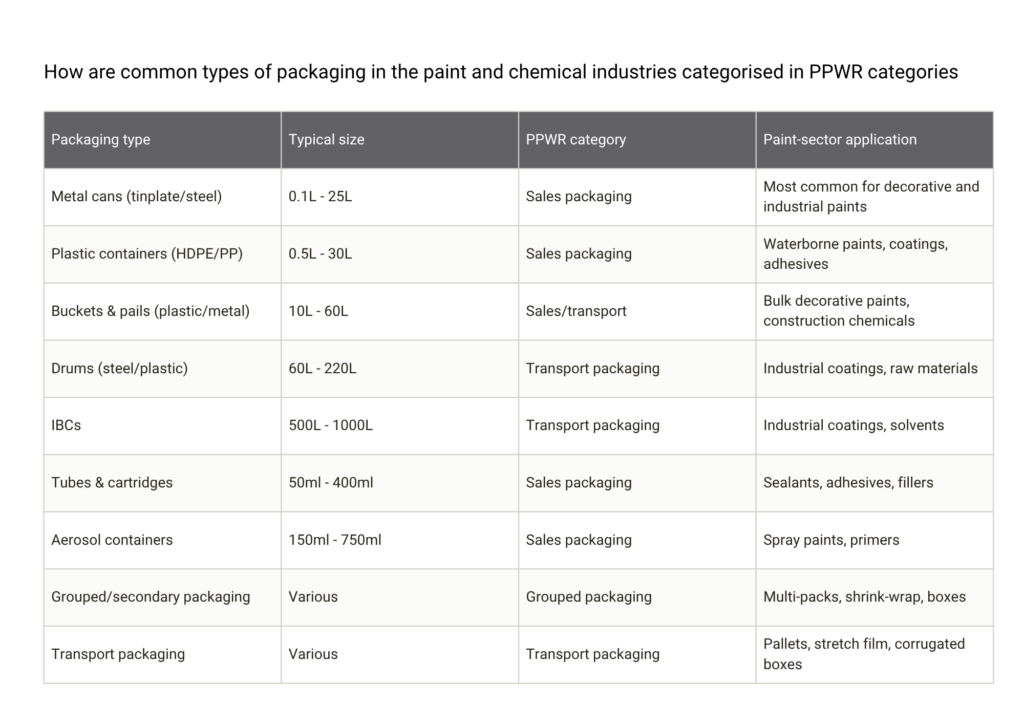
How are common types of packaging in the paint and chemical industries categorised in PPWR categories?
Most cans and containers are defined as Sales packaging. Corrugated cardboard boxes are mainly seen as Transport packaging, but a box can also be Grouped packaging, when the box is placed onto the shelves too. More in the list below.
What are the heavy metal limits?
Heavy metals (Article 5(4)): The combined concentration of lead (Pb), cadmium (Cd), mercury (Hg), and hexavalent chromium (Cr(VI)) in packaging or packaging components must not exceed 100 mg/kg. This limit applies to all packaging, including paint cans, pails, drums, and tubes. Compliance must be demonstrated in the technical documentation under Annex VII.(1)
These limits are already mentioned in the older EU Directive 94/62/EC that is replaced by the PPWR. As far as we know, based on all the information we have received from our material suppliers, all our packaging already comply with the heavy metals limit.
Are the PFAS limits relevant for paint packaging?
The explicit PFAS concentration limits in Article 5(5) apply only to food-contact packaging. Paint and coatings packaging is generally not food-contact packaging, so these specific thresholds (25 ppb individual, 250 ppb sum, 50 ppm total) are not directly applicable. However, Article 5(1) requires that substances of concern be minimised in all packaging. If internal coatings or liners in paint cans contain fluorinated compounds, this should be documented. Additionally, broader REACH restrictions on PFAS may apply independently of the PPWR. The Commission’s implementing acts on material composition identification methodology, due by August 2026, will set the exact rules for multi-material packaging classification.
How is the material of a packaging defined when it has a component like a label or handle that is made from another material than the packaging?
Under the PPWR, packaging is classified by its dominant material. When a minor component like a label represents less than 5% of total packaging weight, two things happen:
- Recycled content exemption (Article 7(3)): plastic components below the 5% weight threshold are exempt from the minimum recycled content requirement. A small plastic label on a metal paint can does not trigger the 35% recycled plastic obligation that would apply if the entire packaging were plastic.
- Material classification: the packaging is classified by its primary material — a steel can with a 2% plastic label is metal packaging, not plastic or composite. This classification drives which design-for-recycling criteria apply (Article 6) and which material composition pictogram appears on the harmonised label (Article 12).
However, the 5% exemption is not a blanket exemption from all obligations — the minor component must still comply with:
- Heavy metals (100 mg/kg limit includes the label)
- PFAS and substance-of-concern minimisation (Article 5(1))
- Documentation in the technical dossier (Annex VII requires material composition of all components, regardless of weight)
The Commission’s implementing acts on material composition identification methodology, due by August 2026, will set the exact rules for multi-material packaging classification.
How do the coatings and prints of a packaging affect the PPWR compliance?
Internal and external coatings on a tin can are typically a fraction of a percent of total weight, so they fall well below the 5% threshold. This means:
- Material classification: the can remains metal packaging — the coating does not change the classification to composite or plastic
- Recycled content (Article 7): the coating is exempt from the 35%/65% minimum recycled plastic requirement, since it qualifies as a plastic component under 5% of total weight
But the lightweight coating is not exempt from:
Technical documentation: the coating type, and composition must be declared in the technical dossier regardless of weight percentage
Heavy metals and PFAS limits
Recyclability assessment (2030): During steel recycling, organic coatings are burned off in the furnace — but if the coating releases hazardous substances or interferes with the steel recovery process, it could lower the design-for-recycling score. This must be assessed qualitatively in the Annex VII documentation.
What is the technical dossier/documentation that PPWR mentions?
Internal and external coatings The PPWR technical dossier (Annex VII) is the evidence file that proves your packaging complies with Articles 5–12. It contains:
- Material composition of all components (substrate, coatings, inks, labels)
- Supplier declarations and test reports (heavy metals, PFAS)
- Design-for-recycling assessment results
- Packaging minimisation justification
- Risk analysis
It must be kept for 5 years (single-use) or 10 years (reusable), ready to submit to authorities within 10 days on request, and supports the EU Declaration of Conformity you sign.
Under PPWR, the manufacturer (including any importer or distributor that is deemed to be the manufacturer under Article 21) is responsible for carrying out the conformity assessment and for creating, updating, and maintaining the technical dossier (technical documentation) for each packaging type..
How does the PPWR interact with dangerous-goods/ADR requirements for paint packaging? [Manufacturers, importers, distributors]
Article 2 (2) provides that where the PPWR conflicts with Directive 2008/68/EC (inland transport of dangerous goods), Directive 2008/68/EC prevails. This means that ADR/UN requirements for dangerous-goods packaging take precedence in case of conflict. However, PPWR provisions that do not conflict with dangerous-goods rules still apply — for example, heavy metal limits, DoC requirements, and (eventually) labelling obligations. Dangerous-goods packaging is exempt from the minimum recycled content requirements (Article 7 (4)) and from certain recyclability requirements (Article 6 (11)).
How important is the recyclability assessment? What is the timeline?
All packaging placed on the market must be recyclable (Article 6(1)). Recyclability is assessed through design-for-recycling criteria (to be established by Commission delegated acts by 1 January 2028) and expressed through performance grades:(1).
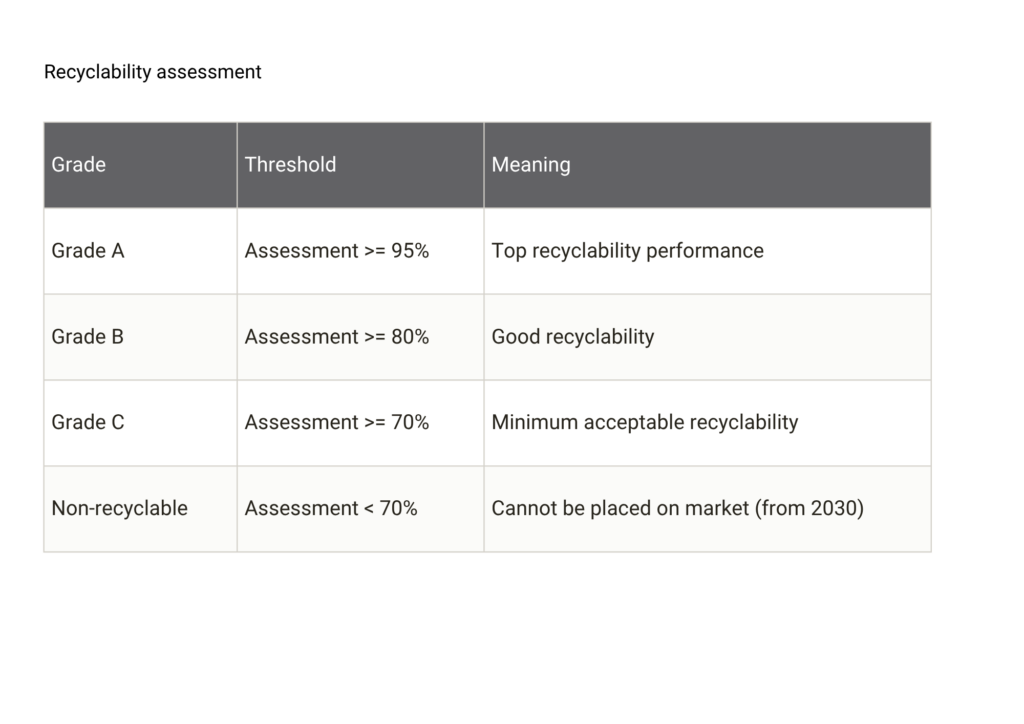
Market access timelines: From 1 January 2030, packaging may only be placed on the market if it achieves Grade A, B, or C. From 1 January 2038, only Grades A and B are permitted — Grade C packaging can no longer be placed on the market. The recycled-at-scale requirement applies from 1 January 2035.
Paint-sector implications: Metal paint cans (tinplate/steel) generally perform well in recycling streams. Plastic containers (HDPE/PP) may face challenges if they include multi-material components, dark colours (carbon black interferes with NIR sorting), or non-removable liners. Composite packaging (e.g., foil-lined tubes) may struggle to meet Grade C thresholds. Manufacturers should begin design-for-recycling assessments now.
Should my packaging already be made from recycled content?
In general metal packaging already consists of 67% or more recycled content (2). From 1 January 2030, plastic packaging must meet minimum recycled content percentages, calculated per packaging type and format as an average per manufacturing plant per year:
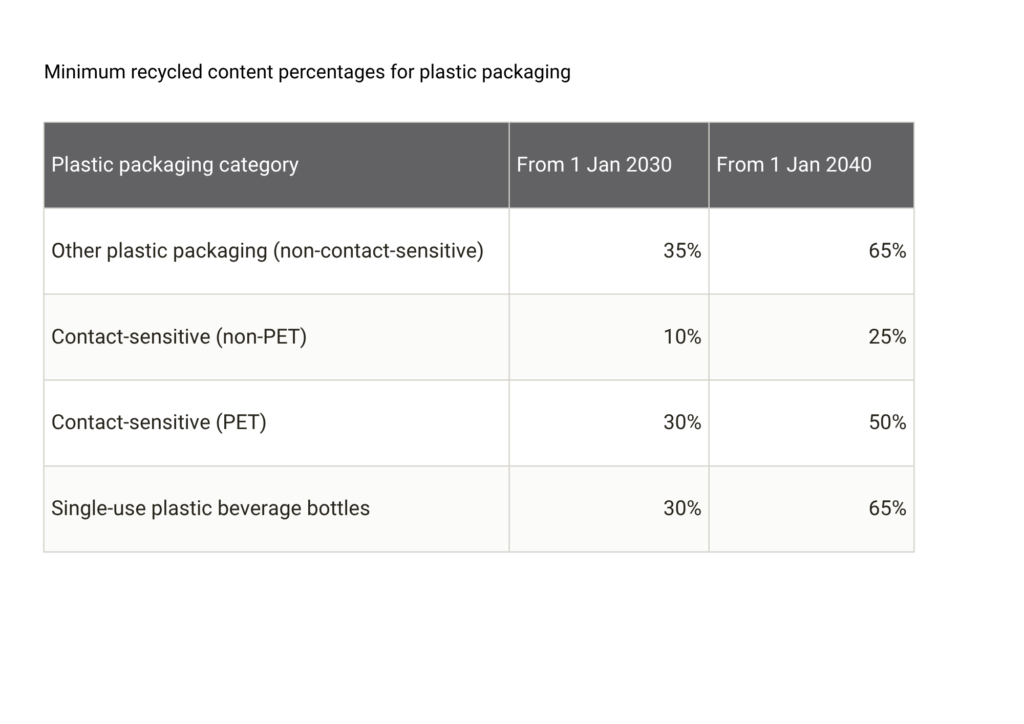
Paint-sector relevance: HDPE/PP paint containers fall under ‘other plastic packaging’, requiring 35% recycled content from 2030 and 65% from 2040. However, this does not apply to plastic food-contact packaging where recycled content would threaten human health, or to plastic parts representing less than 5% of total packaging weight. Dangerous-goods packaging is also exempt.
How can I get the required PPWR data for the packaging I buy from Go!Paint / Hildering Packaging?
If you are producer according to PPWR, simply send us an e-mail and we will send you all data that we have available for the packaging, so you can make your own DoC’s. If you are a distributor we will gladly share lists of data for the packaging we use for our products, also we will hold the DoC’s of these packaging in our system, available at request, fr 5 years (single use) or 10 years (reusable). Our data will be updated regularly. We strive to be complete; however, we cannot guarantee all data will be complete as we are also dependent on the information that we receive from our material suppliers..
Do I need an EU Declaration of Conformity (DoC) for every packaging SKU?
Yes. If you are a producer. Under Article 15(2), before placing packaging on the market, the manufacturer must carry out the Article 38 conformity assessment and prepare Annex VII technical documentation. If conformity is demonstrated, an EU DoC must be drawn up under Article 39. The DoC is required per distinct packaging type/family with the same compliance-relevant design, material composition, coatings/liners, closure system and intended use — not per individual unit. However, where packaging types differ in material composition, coatings, or design, separate DoCs are needed. A single DoC can cover multiple SKUs that share identical packaging specifications.
Do you have a timeline / check list for me that shows what actions I should take now and in the future for PPWR?
Yes. We have 2 check lists to take action: one for Producers/manufacturers and one for Distributors You can download them from this page.
For any further questions, please get in touch with us by filling in the form below.